 how-to
How to Choose False Eyelashes for a Natural Look
Last Updated: November 4, 2026
Quick Summary
To learn how to choose false eyelashes for a natural look, measure your natural lash length first and pick a strip that ends where your own lashes end or adds no more than a couple of millimetres. Then check the pack for a stated length, a light tapered fiber, a flexible band and a gentle J-to-C curl.
- Hold a strip against your bare lash line and keep it within a couple of millimetres of your natural length.
- For a natural look, stay in the J-to-C curl range rather than CC or D.
- A natural taper, longest just past the center, is the safest all-rounder for everyday wear.
- Trim the strip from the outer end in small increments so the band still reaches the outer corner.
- Wait about 30 seconds until the adhesive turns tacky before pressing the band on.
Table of Contents
- Start With a Measurable Natural-Look Test
- Types of Eyelashes Natural Enough for Everyday Wear
- Match Lash Length, Volume and Curl to Your Eye Shape
- Best Fake Eyelashes That Look Natural: What to Check on the Pack
- Natural Fake Lashes for Beginners: A Simple First Application
- Best False Eyelashes for Beginners: Comfort, Sensitive Eyes and Contact Lenses
- Shop Natural-Look Lashes at Pemarch
- Frequently Asked Questions
Start With a Measurable Natural-Look Test
Knowing how to choose false eyelashes for a natural look starts with one number: your lash length.
Here is the test we recommend. Hold a strip against your bare lash line, close one eye, and look straight ahead. The lash should end where your natural lashes end, or add no more than a couple of millimetres. Anything past that starts to look costumey in daylight.
A softer approach usually works better for everyday wear.
Measure Your Natural Lash Line
Use a small ruler and check three points:
- Inner corner: usually the shortest section
- Center: the longest point of your natural lashes
- Outer corner: where flare and lift come from
Write those numbers down. When you shop, compare them to the lash length printed on the pack. If the pack does not state a length, treat that as a warning sign.
The peer-reviewed research on eyelash extension use and eye effects shows that lash wear sits close to the eye, so fit and comfort matter as much as looks.
Types of Eyelashes Natural Enough for Everyday Wear
Strip lashes, individual lashes and clusters all work for a natural look, but they behave differently. Strips give the fastest full result. Individuals blend most invisibly. Clusters sit in between, offering control without the full-strip commitment.
Strip Lashes, Individuals and Clusters Compared
| Type | Wear Time | Skill Level | Best For |
|---|---|---|---|
| Strip lashes | Fastest to apply | Beginner-friendly | A quick, even lash line |
| Individual lashes | Slowest to apply | Practiced hands | Blending with natural lashes |
| Lash clusters | Medium | Improves with practice | Custom fullness at the outer corner |
For most first-timers, a light strip is the easier starting point. Individuals reward patience with the most seamless finish, but they take longer and demand a steady hand.
Match Lash Length, Volume and Curl to Your Eye Shape
Length, volume and curl decide whether lashes open your eyes or close them off. The rule we give shoppers: keep the longest point near the center for round eyes, and near the outer corner for small or hooded eyes.
Read the Curl Letter First
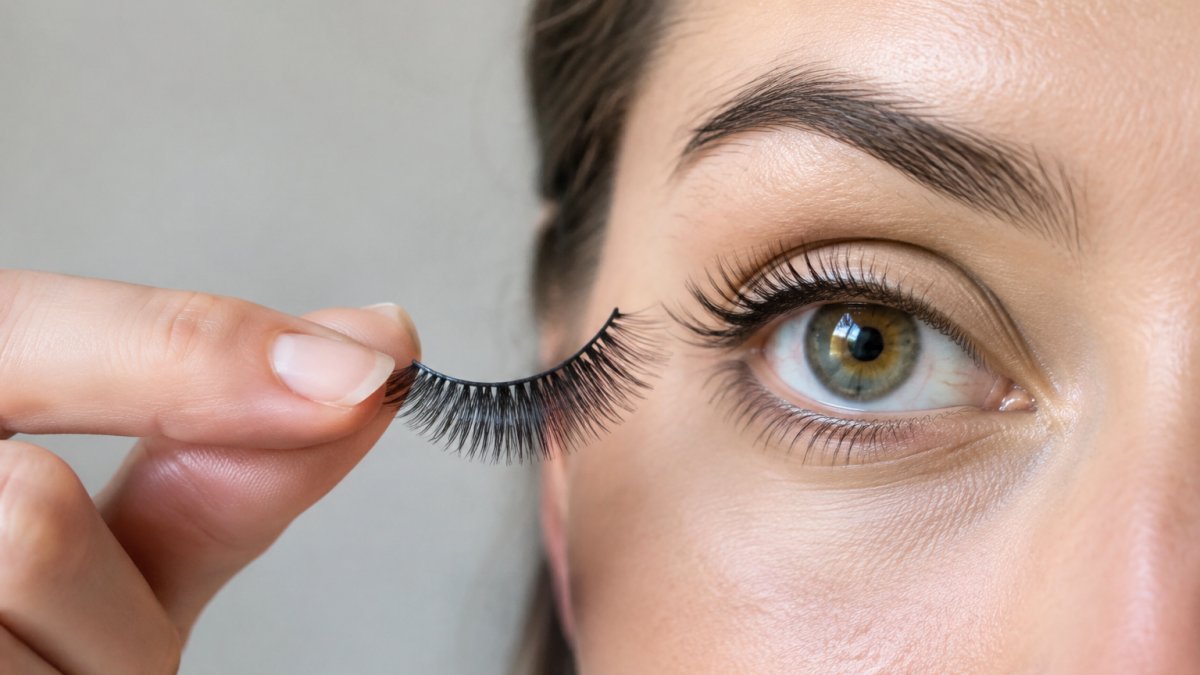
Most lash packs use a letter scale for curl, running from a soft J through B, C, CC and D. For a natural look, stay in the J-to-C range. A J curl is almost straight and disappears against downward-pointing natural lashes; a C curl gives a visible lift without the doll-like arc of a CC or D. If your natural lashes grow straight out or slightly down, a B or C curl reads as "awake" rather than "made up." If your natural lashes already curl upward, a J or B curl blends in best.
Match the Flare Pattern to the Eye
Flare is where the lash is longest. Three patterns cover most natural looks:
- Center-flare (doll): longest in the middle. Opens round eyes and makes them look wider, but on small eyes it can crowd the center and close the eye down.
- Outer-flare (cat): longest at the outer corner. Lifts small and hooded eyes and elongates round eyes, but too much outer length drags the corner down and reads dramatic.
- Natural taper: longest just past the center and tapering at both ends. The safest all-rounder for a soft, everyday finish.
Small, Hooded and Round Eyes
- Small eyes: short length (stay within 1-2 mm of your natural center length), light volume, and a B or C curl that lifts rather than droops. Avoid center-flare strips; a natural taper or a very soft outer flare keeps the eye open.
- Hooded eyes: a flexible, thin band and a slight outer flare so the lash does not disappear into the lid fold. For hooded eyes, band flexibility is often more important than curl.
- Round eyes: center length and a soft taper to elongate the eye width. A C curl with an outer flare stretches the shape; a tight D curl rounds it further.
- Almond eyes: most natural styles suit almond eyes, so choose by band comfort and length rather than by flare pattern.
A tapered end and a soft curl mimic natural lashes best. Heavy density in the center can make small eyes look smaller, so keep volume light.
Watch out: a strip labelled "natural" can still carry a D curl or a heavy center flare. Check the curl letter and the longest point on the strip, not just the word on the box.
Best Fake Eyelashes That Look Natural: What to Check on the Pack
The best fake eyelashes that look natural share three things: a stated length, a light, tapered fiber, and a flexible band. Check these before anything else on the box.
Eco Lashes 453, Sustainable Fibers False Eyelashes, Organic Cotton Band →
- Length in millimetres: compare it to your own measurement
- Band type: clear or thin black bands blend better than thick black bands
- Fiber: synthetic or natural fibers with tapered ends look softer
- Curl: a gentle curl reads natural; a tight curl reads dramatic
- Reusability: reusable lashes cost less per wear over time
Our Eco Lashes 453 list light volume, short length, tapered fibers, and a soft organic cotton band, which suits a soft, natural look.

Natural Fake Lashes for Beginners: A Simple First Application
Natural fake lashes for beginners come down to four steps: trim, glue, wait, press. Skip the wait and the lash slides; skip the trim and the band lifts at the corners. The steps are simple, the failures are predictable, and most of them have a specific fix.
- Trim to fit. Hold the strip to your lash line and cut the excess from the outer end. Cut in small increments; once you remove too much, the strip will not reach the outer corner and the eye looks unbalanced.
- Add adhesive. Run a thin line along the band and wait about 30 seconds until it turns tacky. A thin line is enough, a thick bead squeezes out under the band and shows as a shiny ridge.
- Press and hold. Set the band on the lash line, starting at the center, then press the corners. Hold each corner for a few seconds with the pad of a finger or the blunt end of a brush.
- Blend. Use a clean spoolie to comb the strip into your natural lashes. Comb upward and outward, not straight down, so the fibers interlock instead of separating.
Troubleshooting a Natural Finish
Most "these lashes look fake" problems are fit problems, not product problems. Here is how to diagnose the common ones:
- The band is visible. Either the band is too thick or the strip is sitting above the lash line. Switch to a clear or thin black band, and set the strip on the lash line itself, not on the eyelid. If the band still shows, a thin line of eyeliner along the base hides it without adding weight.
- The lashes are too long. Trim 1-2 mm from the outer end and re-check against your natural lash length. Length is the single biggest driver of a fake look in daylight.
- The lashes are too dense. A full, even strip reads as a solid block. Choose a wispy or tapered style, or cut a strip in half and wear only the outer half for a lighter effect.
- The corners lift. This is usually a glue-timing problem or a band that is too stiff for the eye curve. Let the adhesive get tackier before pressing, and gently flex the band between your fingers a few times before applying to soften it.
- The lashes point the wrong way. The strip is on the wrong eye or upside down. The longer fibers should sit on the outer half of the eye; if they sit on the inner half, flip the strip.
- One eye looks heavier than the other. Natural lashes are rarely symmetrical. Measure each eye separately and trim each strip to its own eye rather than cutting both to the same length.
Keep your tools clean between applications. Our guide on how to clean makeup brushes without damaging bristles covers the safe method.
Watch out: too much glue is the most common beginner mistake. It clumps, shows through the band, and makes removal harder than it needs to be, and pulling a glue-heavy strip off is how natural lashes get damaged.
Best False Eyelashes for Beginners: Comfort, Sensitive Eyes and Contact Lenses
The best false eyelashes for beginners prioritise comfort first. A flexible band, light weight and short wear time reduce irritation, and that matters more if you have sensitive eyes or wear contacts.
A few practical rules:
- Patch test the adhesive on your inner wrist before first use
- Keep wear time short at the start, and remove at the first sign of irritation
- Put contacts in before lashes, and take lashes off before removing contacts
- Remove gently from the outer corner with a proper remover, never by pulling
If you are also building out your kit, our review of the best beauty tools for personal care covers the wider set.
Shop Natural-Look Lashes at Pemarch
Choosing a natural lash is a measurement exercise, not a guessing game. Measure your lash line, match the length, keep the volume light, and pick a flexible band. That combination does most of the work.
Start with a light, short pair and a soft band. Browse our Eco Lashes 453 for a natural, everyday finish, and read the full spec before you order.
Frequently Asked Questions
What size fake lashes should I choose for a natural look?
Aim for a lash length close to your own lashes, with light volume and a soft curl. Measure your lash line and trim the strip to fit before applying. Shorter, tapered fibers with spaced clusters read as natural, while dense, uniform rows look heavier. If you are unsure, start one size shorter than you think you need and check the result in daylight.
Are individual lashes or strip lashes more natural-looking?
Individual lashes and lash clusters usually blend more closely with your natural lashes because you place them under or between your own hairs, so there is no visible band. Strip lashes are faster to apply and easier for beginners, especially with a clear or flexible band. For a natural look, a light strip with tapered ends works well for everyday wear, while individuals suit people who want a softer, more custom finish.
How do I choose false eyelashes for my eye shape?
Match the longest point of the lash to your eye shape. For small or hooded eyes, choose shorter lengths with a curl that opens the eye rather than a heavy flare. Round eyes suit a slightly longer center to elongate, while almond eyes can carry a gentle outer-corner flare. Always trim the band to your eye width and check the fit before gluing, since a band that is too long will lift at the corners.
How can I make false eyelashes blend with my natural lashes?
Curl your natural lashes and apply a thin coat of mascara before placing the lash. Choose a clear or flexible band, trim it to fit, and press the strip along the lash line so the band sits close to your own hairs. Tapered ends and spaced clusters help the fibers merge with your lashes. After application, gently press the strip and your natural lashes together with clean fingers or a lash tool for a seamless finish.
Ready to find a lash that looks like yours, only better? Pemarch lists clear fiber, band and length details on every lash product, so you can compare before you buy. Shop now and get a natural finish you can wear daily.