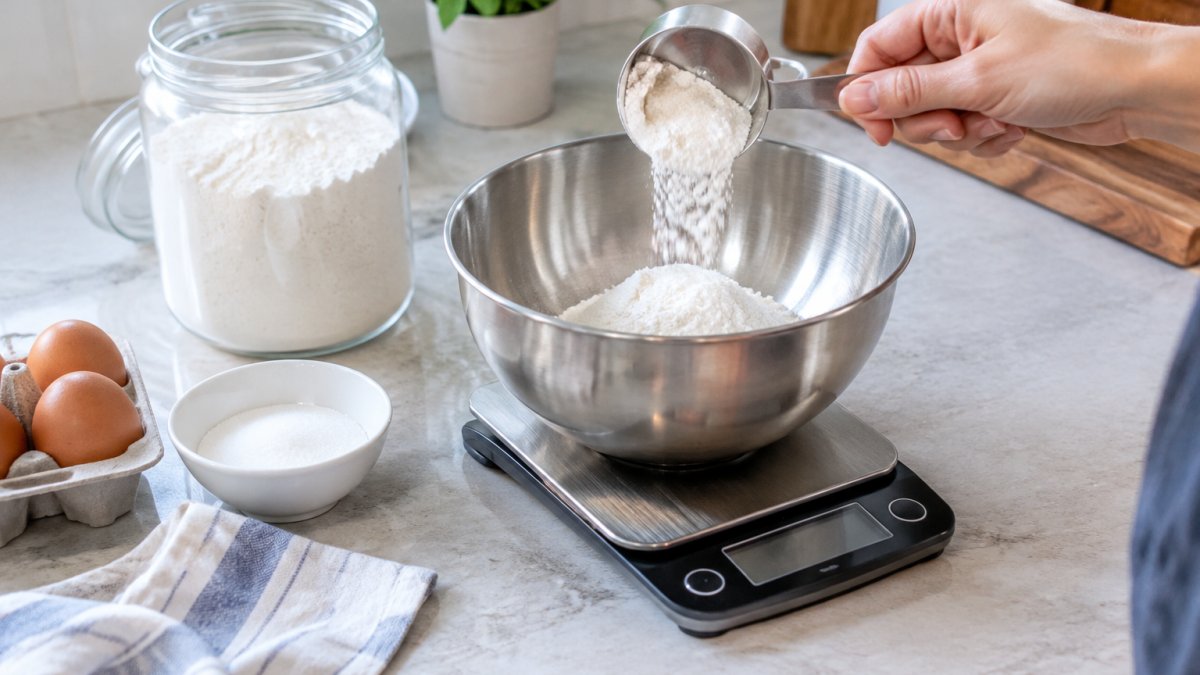
 how-to
7 Steps to Test a Digital Kitchen Scale for Accuracy at Home
Last Updated: November 8, 2026
Quick Summary
To test kitchen scale accuracy at home, zero it on a flat, hard surface, tare an empty bowl, then weigh a known household item, coins, and loads across the range you cook with. Compare readings against the label, official coin masses, and the scale's stated tolerance, repeating each test three times to catch bias or inconsistency.
- A tolerance of roughly one to two grams is a common bar for everyday home cooking.
- Weigh a single coin, then a stack of five, and compare the stack to five times the single mass.
- Calibrate only with certified calibration weights, never with a household item.
- Weigh the same item five times to check repeatability; scatter over a gram or two signals a problem.
- Run the full protocol every few months and after a drop, move, or battery change.
Table of Contents
- Why Your Kitchen Scale Needs a Regular Accuracy Check
- Step 1: Zero the Scale and Tare Your Bowl
- Step 2: Use a Known Household Item as a Test Weight
- Step 3: Test Your Kitchen Scale with Coins for Precision
- Step 4: Compare Readings and Apply Pass/Fail Criteria
- Step 5: How to Calibrate a Digital Kitchen Scale with Calibration Weights
- Step 6: Digital Scale Troubleshooting for Inconsistent Readings
- Step 7: Repeat the Test Across the Scale's Range
- Frequently Asked Questions
Why Your Kitchen Scale Needs a Regular Accuracy Check
A digital kitchen scale is only useful when you can trust the number on its display. If that number drifts, every food measurement built on it drifts too, and small errors add up fast in baking, portioning, and coffee brewing. Learning how to run a test kitchen scale accuracy check at home takes about ten minutes and a few items you already own. Accuracy is the whole point of a measuring tool, which is why this seven-step protocol is worth following. Readers who want reliable home electronics can also browse a guide to affordable electronics for home use.
The stakes are higher than most people expect. A scale that reads a few grams heavy will quietly overshoot every ingredient you weigh. Baking suffers first, because flour and leavening are unforgiving. Portion control suffers next.
What most guides miss is that a scale can be precise and still be wrong. Precision means the display repeats the same number. Accuracy means that number matches reality. You need to test both, and the steps below do exactly that.
Step 1: Zero the Scale and Tare Your Bowl
Start on a flat, hard surface. A countertop works; a soft mat or an uneven tile does not. Press the power button and let the display settle on zero before anything touches the weighing platform.
Now place your empty bowl or plate on the platform and press the tare button. The display should return to zero with the bowl still sitting there. That is the tare function doing its job: it subtracts the container so you weigh only the food.
Two quick checks before you move on:
- The display reads exactly zero with the empty bowl in place
- The reading stays at zero when you press gently on the platform edge and release
If the scale will not hold zero, stop here. A drifting zero makes every later reading meaningless, and you will chase ghosts through the rest of the test.
Step 2: Use a Known Household Item as a Test Weight
The best household test weight is a sealed package with the net weight printed on it. A 1 kg bag of flour, sugar, or rice works well, and so does a 500 g bag of pasta. Check the label for the net weight, not the gross weight.
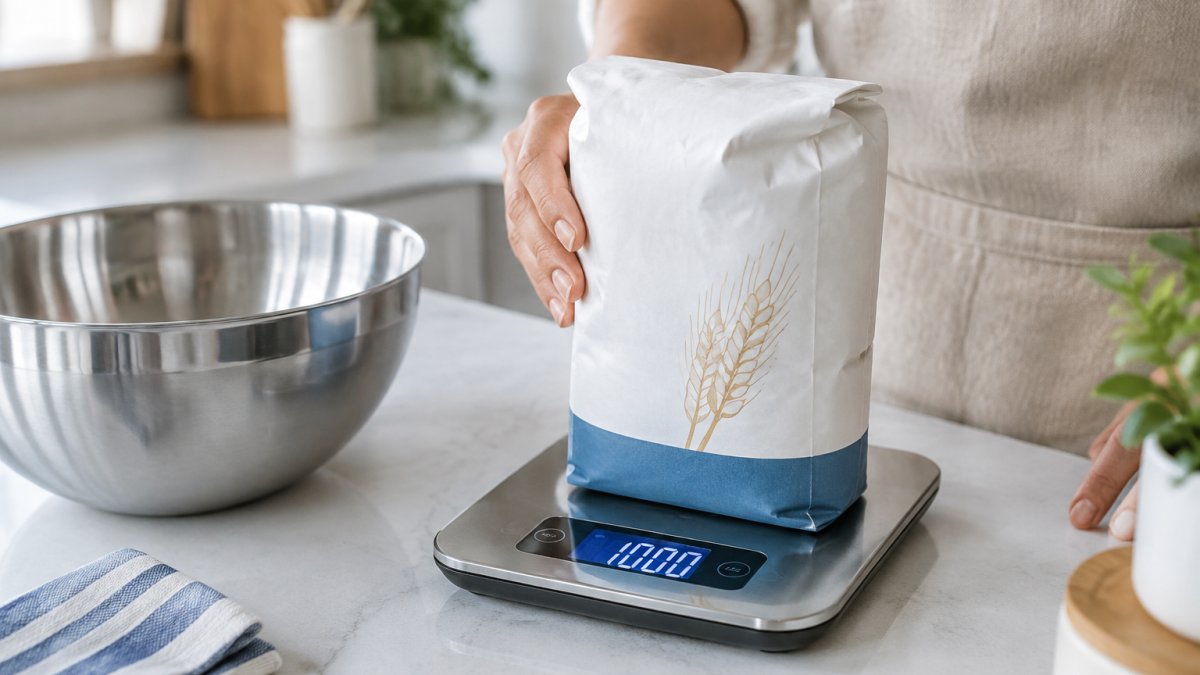
Before you weigh anything, set up a repeatable protocol so the result means something. Choose three test points that span the range you actually cook with: a light load (a single coin or a small spice jar), a mid load (a 500 g package), and a heavier load (a 1 kg package or two mid-weight items combined).
You are looking for two things: how close the average reading sits to the printed weight, and how much the three readings differ from each other. A scale that lands near the label but jumps around between tries has a repeatability problem, which we cover in Step 6. A scale that reads consistently high or low across all three test points has a bias problem, which Step 5 addresses.
Watch out: packaged goods are filled by weight, and the actual contents can differ slightly from the label. Packaged goods are usually filled to a stated net weight, so a 1 kg bag may contain slightly more or less than 1 kg. Treat a household item as a rough sanity check, not a laboratory reference.
A common pattern is that household items are accurate enough to catch a scale that is off by tens of grams, but not one that is off by two or three grams. If your cooking depends on small differences, such as yeast, salt, or coffee, the coin test in Step 3 and calibrated weights in Step 5 are more informative.
Step 3: Test Your Kitchen Scale with Coins for Precision
Coins make excellent small test weights because their masses are tightly controlled. To test kitchen scale with coins, look up the official mass of your local coins, then stack a few and compare.
Here is how to run it:
- Find the official mass of one coin of each denomination you plan to use.
- Weigh a single coin and note the reading.
- Stack five identical coins and weigh the stack.
- Multiply the single-coin mass by five and compare it with the stack reading.
This catches problems that a heavy bag of flour will never reveal. Many scales are accurate in the middle of their range but sloppy at the low end, right where you weigh yeast, spices, or coffee. If the five-coin stack reads noticeably off from five times the single coin, your scale struggles with small masses.
Keep the coins dry and clean. A smudge of oil adds mass, and at this scale, a smudge matters.
Step 4: Compare Readings and Apply Pass/Fail Criteria
Now you need a standard to judge against. A tolerance of roughly one to two grams is a common bar for everyday home cooking. For baking and coffee, tighter is better. The key is to interpret deviations in light of the scale's resolution, its stated tolerance, and what you are measuring.
First, check the scale's resolution. A scale that displays in 1 g increments cannot reliably show a 0.5 g difference, so a reading that is 1 g off may be within the display's rounding. A scale with 0.1 g resolution gives you finer information, but it also demands a more stable environment. Second, check the manual for the manufacturer's stated accuracy or tolerance.
Use this simple framework, adapted to your scale's resolution and stated tolerance:
| Test | What a Pass Looks Like | What a Fail Looks Like |
|---|---|---|
| Zero with empty bowl | Display holds exactly 0 | Drifts or flickers off zero |
| Household item, 3 tries | All readings close to label, tight spread | Wide spread between tries |
| Single coin | Within about 1 g of official mass | Off by several grams |
| Coin stack | Close to the calculated sum | Far from the correct sum |
| Mid-range weight | Within your chosen tolerance | Consistently high or low |
Judge the pattern, not a single reading. One odd result usually means you nudged the scale or the item was off-center. Three bad results in a row means the scale has a real measurement error. If the scale is consistently off by the same amount across test points, that is a bias that may be correctable through calibration. If it scatters randomly, the problem is more likely environmental or mechanical.
Watch out: do not apply a laboratory tolerance to a kitchen scale. A scale that is off by 2 g at 1 kg may be perfectly adequate for portioning stew, but it is marginal for weighing yeast. Match the pass/fail bar to the task, and write down your chosen tolerance so you can compare results over time.
If you want a deeper method for judging whether a device's stated specs match its real behavior, our guide on how to verify electronic product specifications walks through the same pass/fail thinking in more detail.
Step 5: How to Calibrate a Digital Kitchen Scale with Calibration Weights
Calibration is the fix when testing shows a consistent error. A scale that always reads the same amount high or low can often be corrected; a scale that scatters randomly usually cannot.
Calibration weights are the right tool. Buy a set that covers the range you actually use, or use a single certified weight near your most common load. Then follow the maker's calibration sequence, which usually means:
- Enter calibration mode as described in the manual
- Place the specified weight on the platform
- Wait for the scale to accept it and confirm
Not every kitchen scale allows user calibration. Check the manual first. If yours has no calibration mode, you are limited to noting the error and adjusting your readings by hand.
For small, high-precision work, a dedicated pocket scale is often the better answer than fighting a tired kitchen scale. Our precision pocket scale with backlit LCD weighs in grams, ounces, and grains with 0.1 g resolution, which suits coffee, supplements, and small hardware.

Watch out: never calibrate with a household item. Calibrating against an unverified weight bakes that weight's error into every future reading.
Step 6: Digital Scale Troubleshooting for Inconsistent Readings
Inconsistent readings are the most common complaint, and digital scale troubleshooting usually comes down to a short list of causes. Work through them in order.
- Low batteries. Weak power causes drifting displays. Replace them before anything else.
- Uneven surface. A wobbly counter or a soft cloth under the feet throws off the load cell.
- Off-center loading. Place items in the middle of the weighing platform, not on the edge.
- Overload. Exceeding the capacity can damage the sensor permanently.
- Temperature swings. Let a cold scale come to room temperature before weighing.
- Drafts and vibration. Open windows and nearby appliances disturb light loads.
Test repeatability directly: weigh the same item five times, lifting it off between tries. If the readings cluster tightly, the scale is consistent. If they scatter by more than a gram or two, one of the causes above is usually to blame.
Step 7: Repeat the Test Across the Scale's Range
A scale can pass at 500 g and fail at 3 kg. Test across the range you actually use, not just one spot. Build up loads in stages: a coin, a household item, then a combination of items whose weights you have already checked.
Add the individual readings together and compare the total with what the scale shows for the combined load. A correct sum confirms the scale tracks linearly. A total that drifts away from the sum tells you the sensor is straining at the top of its range.
Run this full protocol every few months, and always after a drop, a move, or a battery change. Ten minutes of checking saves a lot of ruined bakes.
A scale you cannot trust is worse than no scale at all, because it makes bad measurements look official. Run these seven steps, note the results, and replace anything that fails twice. Pemarch stocks measuring tools built around precision in every word and every reading, with clear product details so you know exactly what you are buying. Browse the Pemarch range and weigh with confidence.
Frequently Asked Questions
How can I check whether my digital kitchen scale is accurate?
Zero the scale, then weigh a known household item like a 1 kg bag of flour or a 500 ml water bottle (which weighs 500 g). Compare the reading to the expected weight. A reading within 1-2 grams is usually acceptable for home cooking. Repeat with a second item to confirm consistency.
Can coins be used to test a digital kitchen scale?
Yes. Coins have standard weights set by national mints. Weigh 10 coins together for a heavier test load. Check your local mint's official weight specifications and compare the total to your scale's reading.
Why does my digital kitchen scale give different readings each time?
Inconsistent readings often come from an unstable surface, a low battery, or placing items off-center on the weighing platform. Try the scale on a hard, level counter, replace the batteries, and center the item. If readings still vary by more than 2 grams, the scale may need calibration or replacement.
How often should I check my kitchen scale for accuracy?
Check monthly for regular cooking and baking. If you rely on precise measurements for baking or portion control, test weekly. Also test after moving the scale, dropping it, or replacing batteries. Consistent checks catch drift before it affects your recipes.