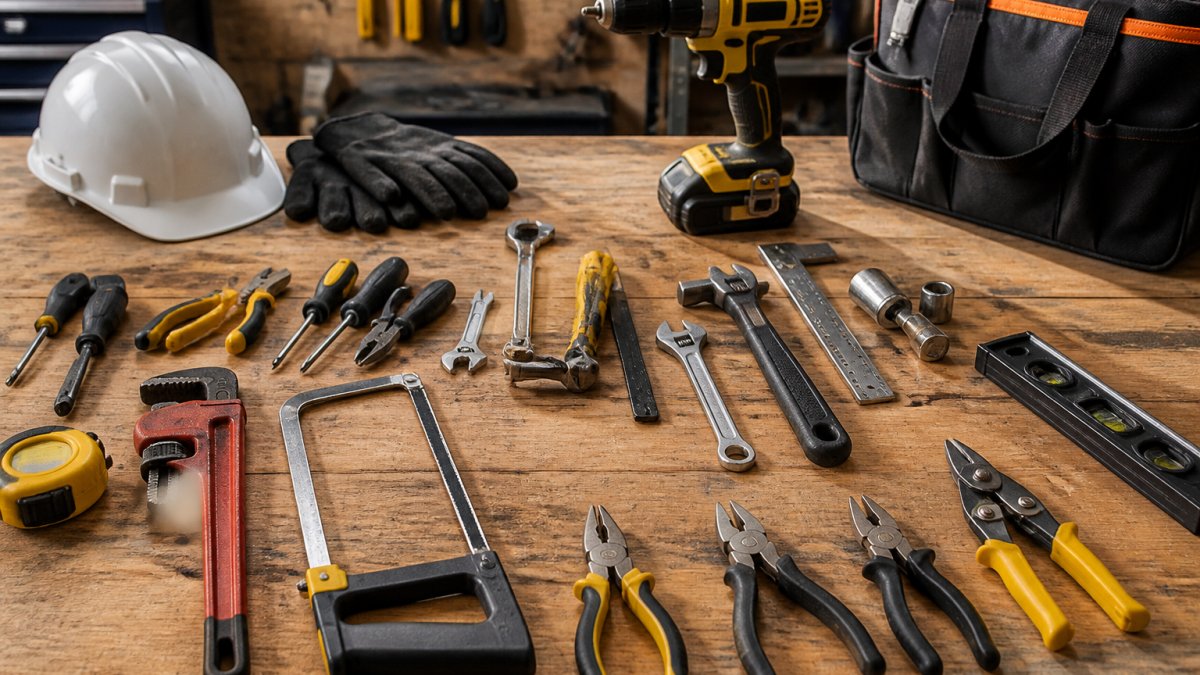
 blog
How to Choose the Best Professional Tools for Home Repair
Last Updated: November 2, 2026
Quick Summary
Choose professional tools by matching grade to use: buy professional grade where a tool takes repeated load, and consumer grade where it does not. Judge each tool on material and hardness, joint and fastener quality, tolerance and fit, serviceability, and ergonomics under load.
- Professional grade is a durability and precision standard, not a marketing label.
- A 450-500 g claw hammer handles most household driving and pulling.
- Own power tools you will use monthly; rent ones you will use once per project.
- Build a kit in three passes: starter, core, then powered tools.
- Keep safety glasses, hearing protection, and work gloves in your kit.
Table of Contents
- What Makes a Tool Professional Grade
- Professional vs Consumer Grade Tools: Where the Extra Money Goes
- Hand Tools Every Repair Kit Needs
- Power Tools Worth Owning and When to Rent Instead
- Building an Essential Tool Kit for New Homeowners
- Tool Organization Ideas for Small Spaces
- Safety Gear and the Mistakes That Cost You Money
- Choosing Your First Professional Tool Set at Pemarch
- Frequently Asked Questions
What Makes a Tool Professional Grade
Professional-grade tools are generally judged by three traits: tighter manufacturing tolerances, materials rated for repeated use, and designs that can be serviced rather than replaced. Professional grade is a durability and precision standard, not a marketing label.
That question matters more than brand names. A hammer is a hammer until you look at how the head is attached to the handle. A screwdriver is a screwdriver until the tip strips on the third screw. Professional tools earn the label at those stress points, and consumer tools cut costs exactly there.
Buying Criteria That Actually Matter
Judge a tool on five measurable things, in this order:
- Material and hardness - forged steel versus cast, hardened tips versus soft ones.
- Joint and fastener quality - how the head, handle, or blade is secured, and whether it can be tightened.
- Tolerance and fit - does the bit seat fully in the screw head without wobble?
- Serviceability - can you replace a worn part, or is the whole tool disposable?
- Ergonomics under load - grip shape and weight balance after twenty minutes, not two.
If you are weighing options online, it helps to know how to verify online product descriptions so the specification sheet you are reading matches the tool that arrives.
Professional vs Consumer Grade Tools: Where the Extra Money Goes
Professional vs consumer grade tools differ mainly in materials, tolerances, and repairability, and the price gap pays for those three things rather than for branding. A common mistake is assuming the difference shows up on day one. It rarely does. It shows up in month eighteen, when the consumer tool has developed play in the joint and the professional one has not.
Where the money actually goes:
- Heat treatment. Hardened working ends resist rounding and stripping.
- Forging versus casting. Forged bodies tolerate impact; cast ones crack.
- Replaceable parts. Bits, blades, and handles that swap out extend the tool's life.
- Quality control. Tighter inspection means fewer duds in the box.
Durability changes the lifetime cost calculation. A tool you replace twice costs more than one you service once. That is the honest case for buying professional grade on the tools you use most, and the honest case against it on the ones you touch twice a year.
Hand Tools Every Repair Kit Needs
Start with hand tools, because they cover the widest range of household maintenance tasks for the least money. A workable core set is small: a claw hammer, a multi-head screwdriver, a screwdriver set, two pairs of pliers, an adjustable wrench, a utility knife, a tape measure, a level, and a combination square.
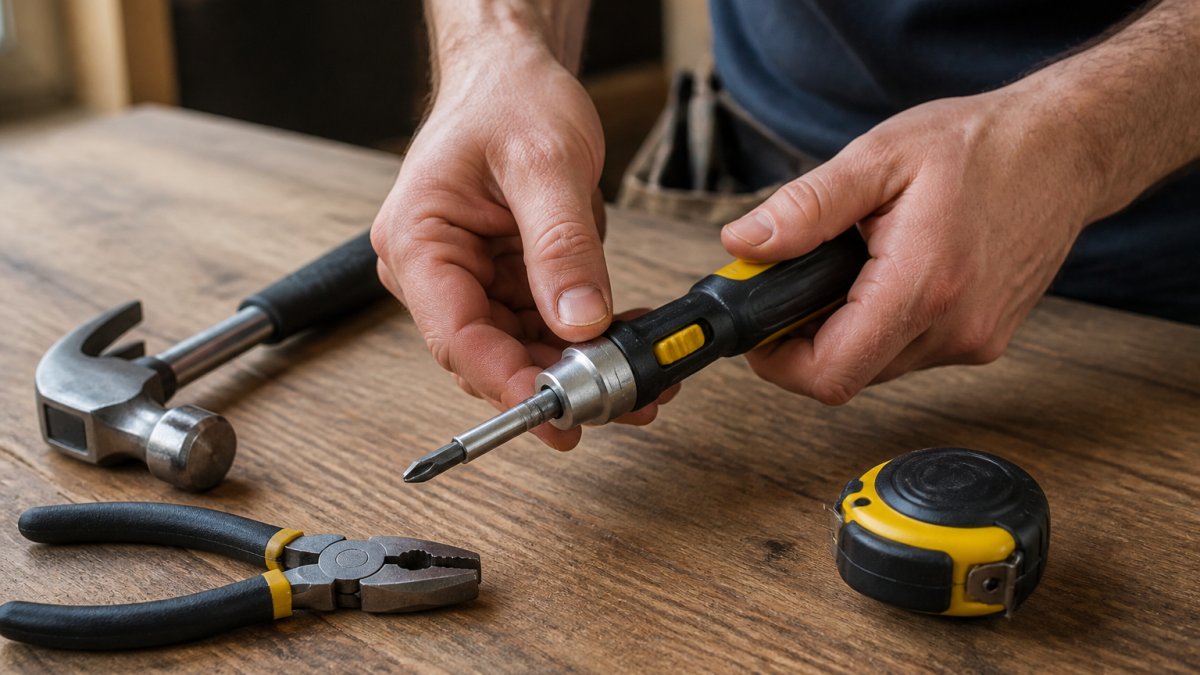
Hammers, Screwdrivers, Pliers and Wrenches
Hammers. A 450-500 g claw hammer handles most household driving and pulling. Check that the head is securely wedged and the handle absorbs shock. On a professional-grade hammer, look for a forged head and a handle joint that can be re-wedged rather than a head that is glued and pinned.
Screwdrivers. Buy a multi-head screwdriver for convenience and a proper screwdriver set for precision. The set matters more: a tip that fits the screw exactly is what prevents cam-out and stripped heads.
Pliers. Two types cover nearly everything: combination pliers for gripping and cutting, and needle-nose pliers for reaching into tight spaces. Add locking pliers if you work on plumbing or stripped fasteners; the jaw teeth and pivot are where cheap pliers fail first. A professional-grade pivot is riveted or bolted so it stays tight instead of developing side-to-side play.
Wrenches. An adjustable wrench is the versatile default. Add a fixed-size wrench in the size your most common household fittings use.
Matching Hand Tools to Common Repairs
The professional-tools question is easier to answer when you map tools to the jobs you actually face. A common pattern is that homeowners buy a broad kit and still lack the one tool a specific repair needs.
- Drywall repair: a 4-6 inch putty knife, a wider taping knife, a utility knife for cutting patches, and a rasp for smoothing edges. A screwdriver used to pry out a damaged anchor snaps its tip.
- Plumbing fixes: adjustable wrench, basin wrench, locking pliers, and a supply-line wrench for under-sink work. Tape and thread sealant matter as much as the wrench.
- Furniture assembly: a multi-bit driver with hex and Torx bits, a rubber mallet, and a small level. An impact driver on furniture hardware strips particleboard in seconds.
- Woodwork and trim: a combination square, a marking knife, a block plane, and a fine-tooth saw. Precision hand tools outperform power tools on small, visible cuts.
Watch out: the most common hand-tool mistake is buying a large set with many low-grade pieces instead of fewer professional-grade tools at the stress points you use weekly. A stripped screwdriver tip or a hammer head that loosens costs more in damaged fasteners and rework than the price difference between grades.
Power Tools Worth Owning and When to Rent Instead
Own the power tools you will use monthly; rent the ones you will use once per project. That single rule saves more money than any brand comparison. A cordless drill and an impact driver sit at the top of the own list. A circular saw earns its place if you cut sheet goods more than a few times a year. An oscillating multi-tool is the sleeper pick: it handles flush cuts and sanding in tight spots that nothing else reaches.
Buying Criteria for Professional-Grade Power Tools
Compare cordless tools on measurable specifications rather than marketing claims. These five criteria commonly separate professional-grade tools from homeowner models:
- Torque and speed under load. A drill rated for higher torque holds speed when a bit binds; a weak drill stalls. Impact drivers are rated in inch-pounds, drills in inch-pounds or newton-meters, and the number matters less than whether the tool maintains it through the cut.
- Battery platform and voltage. Voltage is not a quality score by itself. What matters is whether the platform offers the tools you will add later, whether batteries are cross-compatible, and whether the charger is included.
- Chuck and bit retention. A metal keyless chuck with a tight grip holds bits without slipping; a plastic chuck wobbles and rounds bits. For impact drivers, check the bit holder for a locking collar that does not release mid-task.
- Weight and balance. A heavier tool is not automatically stronger. Balance in the hand matters more than total weight after twenty minutes of overhead work.
- Warranty and serviceability. A tool you can service generally outlasts one you replace.
When to Rent or Hire a Professional
Rent or hire instead when the tool is large, single-purpose, or dangerous without practice. Rotary hammers, tile saws, and floor sanders fall into that group. The rental cost is predictable; the storage and maintenance cost of ownership is not.
A practical rent-or-hire test: if the tool costs more than the rental fee times the number of times you expect to use it in five years, rent. If the repair involves a permit, a gas line, or a load-bearing wall, hire.
One more decision: pick a battery platform and stay on it. Batteries can be a significant long-term expense, and mixing platforms can mean duplicating chargers and packs.
Building an Essential Tool Kit for New Homeowners
An essential tool kit for new homeowners should cover measuring, fastening, gripping, cutting, and safety before it covers anything powered. Build it in three passes so the spending tracks your actual repair projects.
| Stage | What to add | Typical use |
|---|---|---|
| Starter | Tape measure, level, screwdriver set, hammer, utility knife | Hanging, tightening, opening |
| Core | Pliers, adjustable wrench, drill bits, fasteners, stud finder | Assembly, minor fixes |
| Powered | Cordless drill, impact driver, circular saw | Shelving, framing, repairs |
Buy the starter pass first and let real repair projects tell you what to add next.
Tool Organization Ideas for Small Spaces
Tool organization ideas for small spaces work best when they follow use frequency rather than tool type. Keep the daily tools visible and the occasional ones stored. A wall-mounted pegboard or magnetic strip handles the first group; a lidded toolbox handles the second.
- Store by task: a small "hanging things" pouch beats a giant box you have to dig through.
- Keep batteries and chargers together on one shelf, away from heat.
- Label drawers by project type, not by tool name.
- Use vertical space above workbenches for long items like levels.
If you want concrete storage picks rather than principles, our roundup of the best tools for home organization covers the products that hold up.
Safety Gear and the Mistakes That Cost You Money
Safety gear is cheaper than the injury it prevents, and it is the most commonly skipped part of a tool kit. At minimum, keep safety glasses, hearing protection, and work gloves on hand, and add a dust mask for sanding and drilling.
Watch out: the most expensive mistake is using the wrong tool for the job because it is closer. A screwdriver used as a pry bar snaps its tip; pliers used as a hammer damage the joint. Both failures cost you the tool and the task. The second costly habit is skipping eye protection during a "quick" cut, which is exactly when debris flies.
Choosing Your First Professional Tool Set at Pemarch
Choosing your first professional tool set comes down to matching grade to use: buy professional grade where the tool takes repeated load, and consumer grade where it does not. That is the whole framework, and it beats any brand loyalty.
Pemarch aims to present product specifications clearly, so readers can compare them before buying.
Frequently Asked Questions
What tools should every homeowner have for basic repairs?
A working starter set covers a claw hammer, a multi-head screwdriver, slip-joint and locking pliers, an adjustable wrench, a utility knife, a tape measure, a spirit level and a stud finder. Add a cordless drill with a bit set and you can handle most household maintenance, from hanging shelves to tightening cabinet hinges. Buy professional tools for the items you use weekly and mid-range versions for the ones that sit in the toolbox.
Are professional tools worth the extra cost for home use?
For tools you reach for often, yes. Professional tools for home repair typically use better steel, tighter tolerances and replaceable parts, so they survive years of DIY projects instead of one season. A pro-grade drill or hammer usually costs more up front but spreads that cost across a decade of use. For rarely used specialty items, a consumer-grade version or a rental is the smarter spend.
What is the difference between DIY and professional-grade home tools?
The gap sits in materials, precision and repairability. Professional vs consumer grade tools differ in hardened steel versus cast components, machined jaws versus stamped ones, and serviceable parts versus sealed units. Professional tools also carry clearer specifications, so you know the torque, voltage or hardness before you buy. Consumer tools often hide those numbers, which makes comparison shopping harder.
How do you organize professional home repair tools effectively?
Start with a wall-mounted pegboard or a modular toolbox that fits your space, then group tools by task rather than type: measuring, fastening, cutting and gripping. Label drawers and use dividers so small items like drill bits and fasteners stay visible. For small spaces, tool organization ideas like under-bed rolling cases, magnetic strips and vertical rails keep a full kit accessible without eating floor space.
The challenge is not finding tools; it is knowing which ones deserve the professional-grade spend. Pemarch gives you the specification detail to make that call with confidence. Browse the catalog for precise product descriptions, clear material and sizing information, and support you can actually reach when a question comes up. Get started with Pemarch and build a tool kit you will not need to replace.